
Most autonomous drone programs do not fail because the technology falls short or the ROI is weak. They fail because the organization never reaches a decision to move forward.
We spend our days at FlytBase helping enterprises deploy autonomous drone programs across security, utilities, and industrial inspection. Across those deployments, the same pattern emerges repeatedly. The value is obvious, and the approval is the hard part. It is the single most important thing to understand when building the business case for autonomous drones. The teams that get to yes have learned what most business cases miss: the value that funds a program is not sitting on the surface, where the math is easy. It is buried a few layers down.
Why Cost Savings Alone Rarely Get an Autonomous Drone Program Approved
Every business case starts with replacement, because replacement is the number everyone understands. In one of our enterprise deployments, a global manufacturer securing a much larger site found that scaling its physical guard force would run into tens of millions of dollars a year. A hybrid model, drones handling routine coverage with a leaner human team, reduced operating costs by more than 50%.
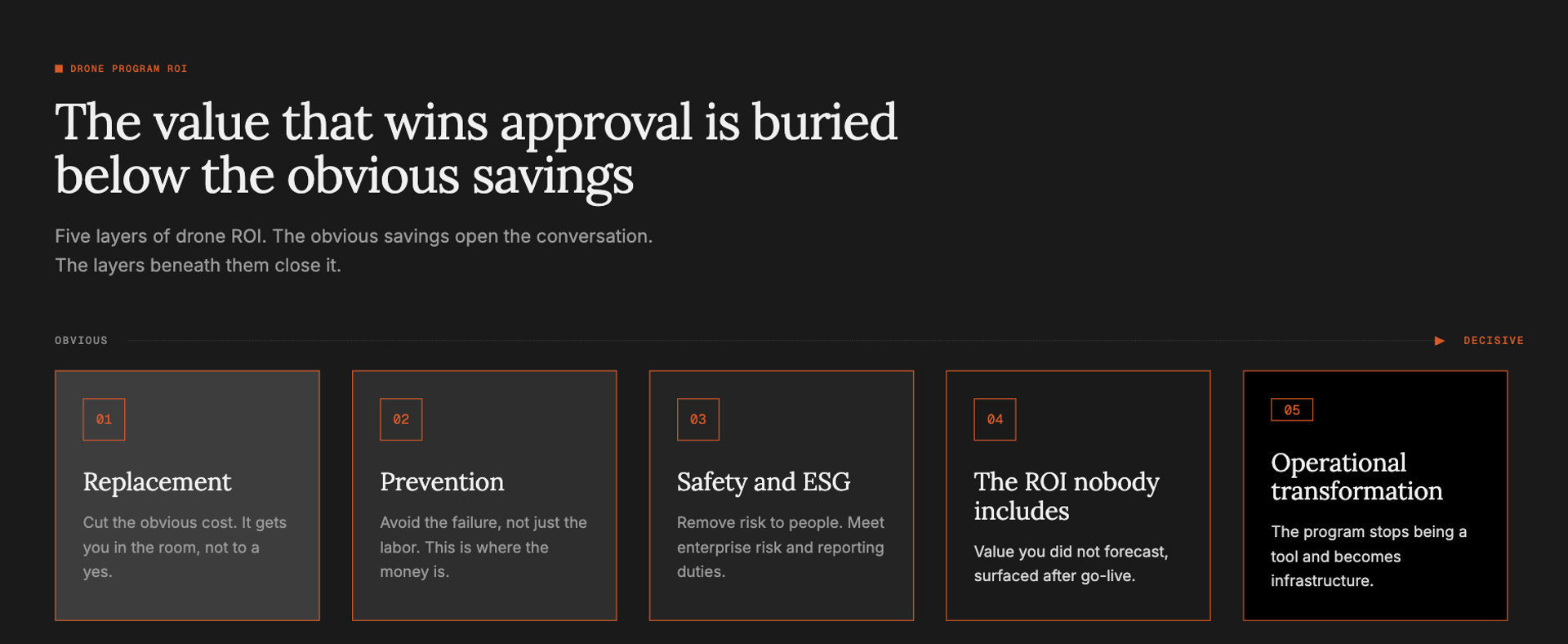
But the number was never really the point. A case built only on replacement invites a line-by-line fight over whether the drone is truly cheaper, and it quietly anchors the whole program to the smallest version of its value. Replacement gets you in the room. It rarely gets you the yes.
The Value That Actually Wins Approval: Preventing the Failure, Not Just Cutting the Cost
The value that wins approval usually sits under the obvious savings, and prevention is the clearest example. One national grid operator we work with was spending around two million dollars a year flying helicopters to inspect power lines across brutal terrain, with three-person crews and hundreds of tons of CO2. The labor savings were compelling. But the number that stopped the room was different. A single multi-hour outage can cost a hundred to three hundred thousand dollars, and the societal cost runs far higher. Preventing one of those pays for the entire drone program.
Then there is the story people remembered. On one of its high-voltage spans, dozens of vibration dampers began to fail. Left alone, a few failures cascade into many, and the line can tear itself apart. The repair was done live on an energized line, by crews suspended beneath helicopters, at roughly thirteen thousand dollars per damper. One operation ran about four hundred thousand dollars. A single drone dock, inspecting frequently, would have caught the first two or three failures for a rounding error. Prevention is impossible to put cleanly in a spreadsheet cell, which is exactly why it is the most persuasive thing in the room.
Safety, ESG, and Enterprise Risk
Below prevention sit the layers that rarely win a case alone and quietly make every case stronger. Safety is the one people feel. When your inspection method puts a person beneath a helicopter beside a live high-voltage line, removing that risk is not a soft benefit. If a drone prevents one dangerous mission or one serious injury, how do you even price that?
For many publicly listed companies, reducing exposure to high-risk inspections is no longer only an operational decision. It is part of enterprise risk management and ESG reporting. Emissions belong in the same layer. Replacing a thousand hours of helicopter flight removes hundreds of tons of CO2 a year, and for a state-owned or publicly accountable operator, that now lands in mandatory reporting, not just good intentions. None of these factors wins approval on its own. Together they make the case very hard to argue with.
The ROI Nobody Includes in the Business Case
The deepest layer never appears in the original business case, because you cannot forecast it. A program justified on patrols starts catching things nobody budgeted for. In six months, one of our security deployments flagged nine events that physical guards had missed entirely, including a break-in, a chemical spill, and an attempted espionage incident. A system bought for one job turns into infrastructure that does several: security, analytics, situational awareness, faster response. The ROI you modeled was for version one. The value keeps compounding into versions you did not know to promise.
Why Good Drone Programs Stall Inside the Organization
If the value runs this deep and this obvious, why is approval so hard? Because value is not the blocker. The organization is. A single deployment can require partnering with several departments at once, and every stakeholder evaluates the same program through a different lens:
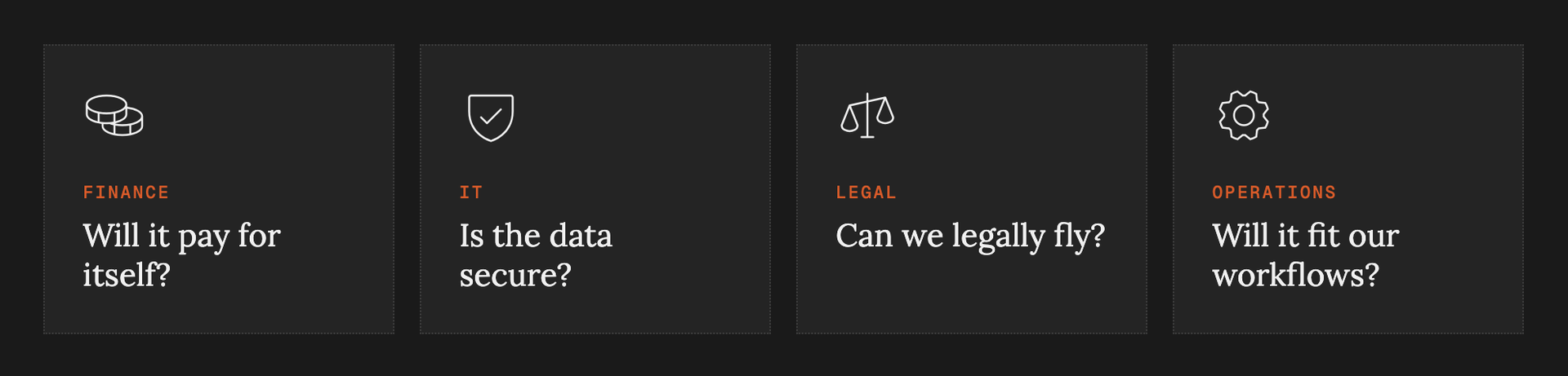
Any one of them can stall the program. Most programs die in a meeting, not on the technology.
How the Teams That Get Approved Actually Do It
The programs that get funded share a short list of habits:
- Start small and let evidence do the arguing. One drone, one site, a few weeks to live operations, and a clean set of results beats any projection.
- Define success metrics upfront, and your own metrics, not the vendor's. One customer watched a well-known robotics vendor hit every metric it promised and still fail to prove ROI, because the metrics were the vendor's, not the business's.
- Map every stakeholder before you need a yes, and hand one internal champion the finance, security, and legal answers before those teams ask.
- Budget two to three times the timeline you were promised. Enterprise approvals always run longer than the vendor slide says.
- Stay honest about fit. Just because a drone can do something does not mean it should. The strongest teams ask whether it is genuinely useful to the mission, and they accept that drones do some things brilliantly and cannot replace a physical presence or a human response.
Organizations rarely approve an autonomous drone program because someone proved the drone is cheaper. They approve it because someone proved the drone changes how the business manages risk, responds to incidents, and operates at scale. The ROI starts the conversation. The deeper value is what finishes it.
At FlytBase, that is the work: helping enterprises build hardware-agnostic, secure autonomous drone programs that integrate with existing enterprise systems and workflows, so the value holds up long after the first spreadsheet. If you are building the business case for autonomous drones, see how one enterprise cut security costs with autonomous surveillance in the Premier Security case study, or how a major utility scaled autonomous inspections to a gigawatt of coverage in the EnBW case study.
Frequently Asked Questions
What is the biggest challenge in getting an autonomous drone program approved?
For most enterprises, the challenge is organizational alignment rather than proving ROI. Finance, IT, legal, operations, and security each evaluate the program differently, so successful business cases address every stakeholder's priorities.
What metrics matter most when building a business case for autonomous drones?
Beyond labor savings, the strongest business cases include avoided outages, improved safety, reduced emissions, faster incident response, and long-term operational value.
What is prevention value in a drone ROI business case?
Prevention value is the cost of the failures a program helps you avoid, such as unplanned outages, emergency repairs, or safety incidents. It is often larger than the labor savings from replacing manual inspections. In many deployments, preventing a single major failure can pay for the entire program.
Do autonomous drones replace security guards or human inspection teams?
No. The strongest programs use a hybrid model. Drones handle routine monitoring, verification, and coverage at scale, while human teams handle investigation, judgment, and physical response. Drones extend a team's reach rather than replacing a physical presence.
How do you prove ROI for an autonomous drone program before scaling?
Start small. Deploy one drone at one site, define your own success metrics upfront, and let real results replace projections. A proven pilot with clear, business-owned metrics is far more persuasive than a forecast, and it is what earns budget for expansion.
How long does it take to deploy an enterprise autonomous drone program?
It varies, but enterprise approvals almost always take longer than vendor timelines suggest. A useful rule of thumb is to budget two to three times the initial estimate, because stakeholder alignment, IT security reviews, and legal or regulatory approvals add time beyond the technical deployment.