
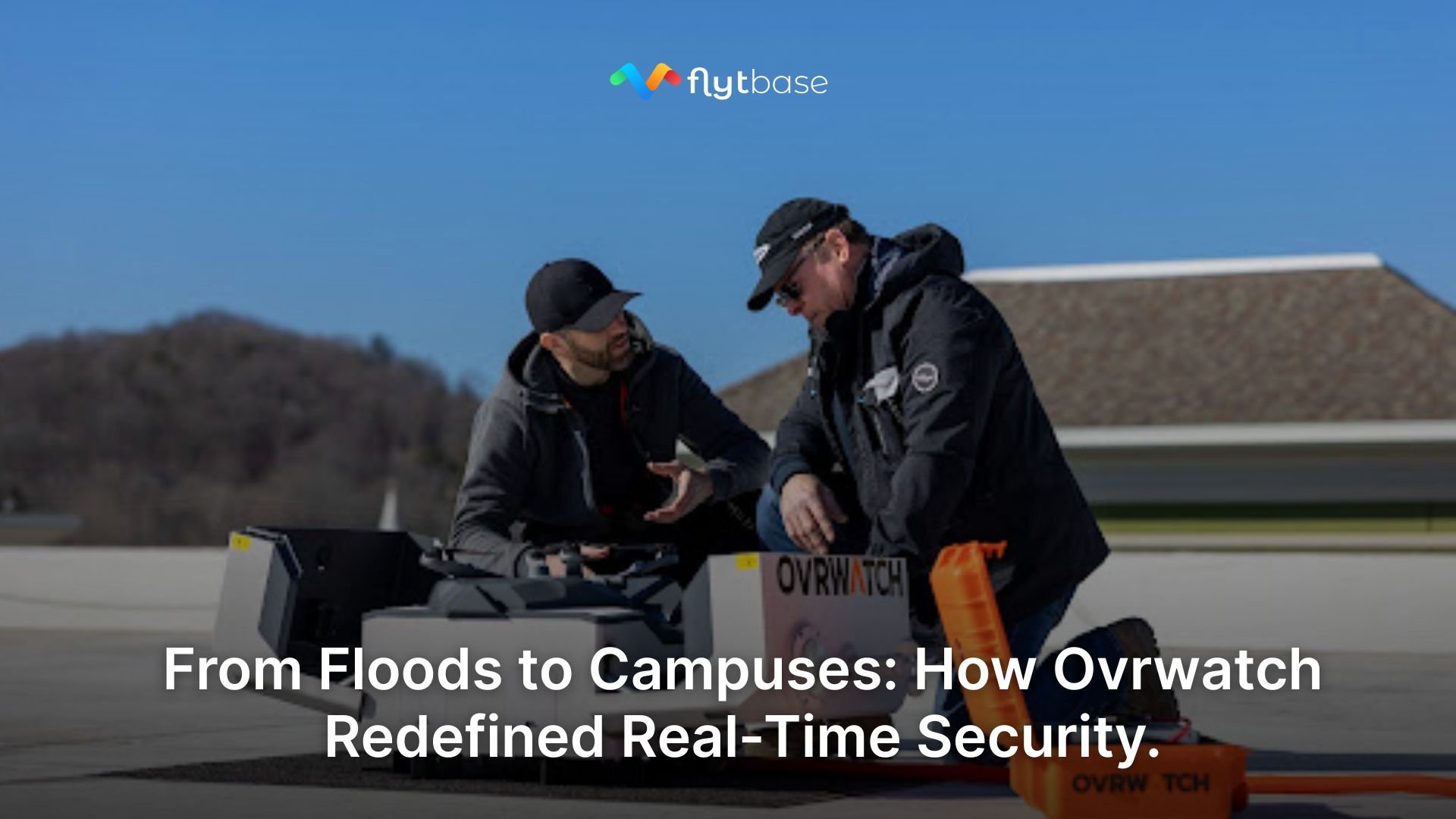
When Hurricane Helene hit Asheville, North Carolina, Ovrwatch didn’t show up with a plan, they showed up with a purpose: to prove that drones could make a measurable difference in real-time disaster response.
Rhys Anderson and his team built a citywide Drones-as-First-Responder (DFR) network—multiple DJI docks connected through FlytBase’s orchestration software, streaming live video to emergency teams that were still wading through floodwater. What started as an experiment soon became one of the most community-driven, data-backed drone deployments in the country.
“Our biggest goal was just to get that first win,” Rhys said during the webinar. “To show that autonomy could actually work in chaos.”
From Emergency Response to Everyday Security
The same principles that held a flooded city together are now defining campus security. When Rhys was asked what happens when drones move from crisis zones to controlled environments, his answer was clear: the fundamentals don’t change—only the stakes do.
The Ovrwatch approach focuses on three non‑negotiables:
- Interoperability: Drones, docks, and data systems must communicate seamlessly.
- Transparency: Stakeholders—from police to IT teams—must see and trust what the drones see.
- Adaptability: Every site is unique; autonomy must flex around it, not force conformity.
These priorities align with FlytBase’s ecosystem philosophy—providing the open, hardware-agnostic platform that enables partners like Ovrwatch to orchestrate multiple drones, docks, and alarm systems from a single command center.
What Asheville Taught Ovrwatch (and Every Security Leader)
Every innovation starts as an experiment—and Asheville proved three lessons that now shape how campuses deploy autonomous security operations:
- Autonomy starts with alignment. The toughest task wasn’t coding the flight path—it was getting public officials, private partners, and IT leaders to agree on who controls what.
- Connectivity is the silent risk. Rhys noted that even the best drone can’t perform if its network drops. The team learned to plan redundancies and backup links, often relying on Starlink as a temporary bridge.
- Visibility builds trust. By letting stakeholders see real-time footage via FlytBase’s secure console, Ovrwatch turned skeptics into advocates.
“You can’t wait for everyone to say yes,” Rhys said. “You start with what works, show the proof, and scale from there.”
Building the Future Campus Security Stack
For campuses today—universities, business parks, industrial facilities—the playbook is straightforward but powerful. Rhys describes it as “autonomy by design.”
A well‑architected deployment begins with:
- Two or more drone docks providing full-site coverage with overlap.
- Alarm and video integrations that trigger instant launches.
- Multi‑agency access through FlytBase’s interface for unified response.
- Secure data management under FlytBase Shield, ensuring compliance and privacy.
Each of these building blocks transforms reactive security into predictive visibility—where drones don’t just respond, they anticipate.
Beyond the Drone: The Human Layer
Despite the impressive hardware and automation, Rhys emphasized that autonomy only succeeds when people trust it.
“Sometimes, the hardest part isn’t getting the drones flying—it’s getting people on the same page,” he said. “Relationships are the infrastructure.”
That trust is built on transparency, data integrity, and clear escalation workflows—areas where FlytBase’s orchestration tools quietly enable consistency and coordination without overshadowing the operators or mission owners.
Key Takeaways from the Webinar
- First wins matter: Start small, prove value, then scale.
- Integration beats isolation: Choose systems that complement existing infrastructure.
- Security is now shared: IT, operations, and public safety teams must collaborate.
- Data security is non‑negotiable: Enterprise‑grade compliance and access control are baseline, not bonus.
- Autonomy grows through partnerships: Between integrators, software providers, and security leaders.
Closing Reflection
The story of Ovrwatch and FlytBase highlights how partnership—not platform alone—drives meaningful autonomy. The same technology that brought clarity to chaos is now quietly enabling confidence across campuses worldwide.
“It’s not about replacing people,” Rhys concluded. “It’s about giving them better eyes, faster.”