
Security teams everywhere are trying to understand how autonomous drones fit into their operations. The interest is strong. The uncertainty is predictable. Most providers want clarity on packaging, BVLOS, pricing, mission design, and how to scale without creating operational complexity.
This blueprint gives you a repeatable model built from real deployments, real mistakes, and thousands of flight hours.
Why Security Teams Are Turning to Autonomous Patrols Now
Across North America, Europe, and the Middle East, security buyers have stopped asking about battery life, payloads, and flight time. They now focus entirely on outcomes they can measure.
They want fewer incidents, faster response, and better visibility without adding headcount.
From conversations with providers, three challenges appear again and again:
- Proving ROI without guesswork
- Designing a model they can repeat across sites
- Scaling operations without rebuilding the process every time
These are business problems, not hardware problems. Providers succeed when they have a structured approach that connects site type, pricing, mission design, and regulatory planning into one system.
Every Security Site Falls Into One of Four Patterns
Your site type determines your mission plan, pricing model, and BVLOS approach. Even across dozens of deployments, almost every environment fits into one of these four categories.
1. Perimeter-Heavy Sites Need Consistent Coverage
Warehouses, malls, and logistics hubs require long-distance patrols and visibility across blind zones that cameras cannot reach. Incidents often occur at night when the site is quiet but vulnerable.
2. Clustered Asset Zones Depend on Fast Event Response
Car dealerships and rental yards have smaller areas but higher-value assets. Events escalate in seconds. These sites benefit most from automated dispatch triggered by VMS or sensors.
3. Hazardous Industrial Sites Prioritize Worker Safety
Chemical plants, utilities, and O&G facilities need a way to monitor critical infrastructure without exposing workers to risk. Drones complement safety teams through thermal checks and compliance evidence.
4. Multi-Site Estates Scale Through Centralized Operations
Campuses, colleges, and gated communities do not see frequent incidents, but when something happens, the impact is serious. Providers centralize operations and run multiple docks from a single ROC.
Understanding these patterns early prevents costly efforts later when selecting missions, pricing, and BVLOS pathways.
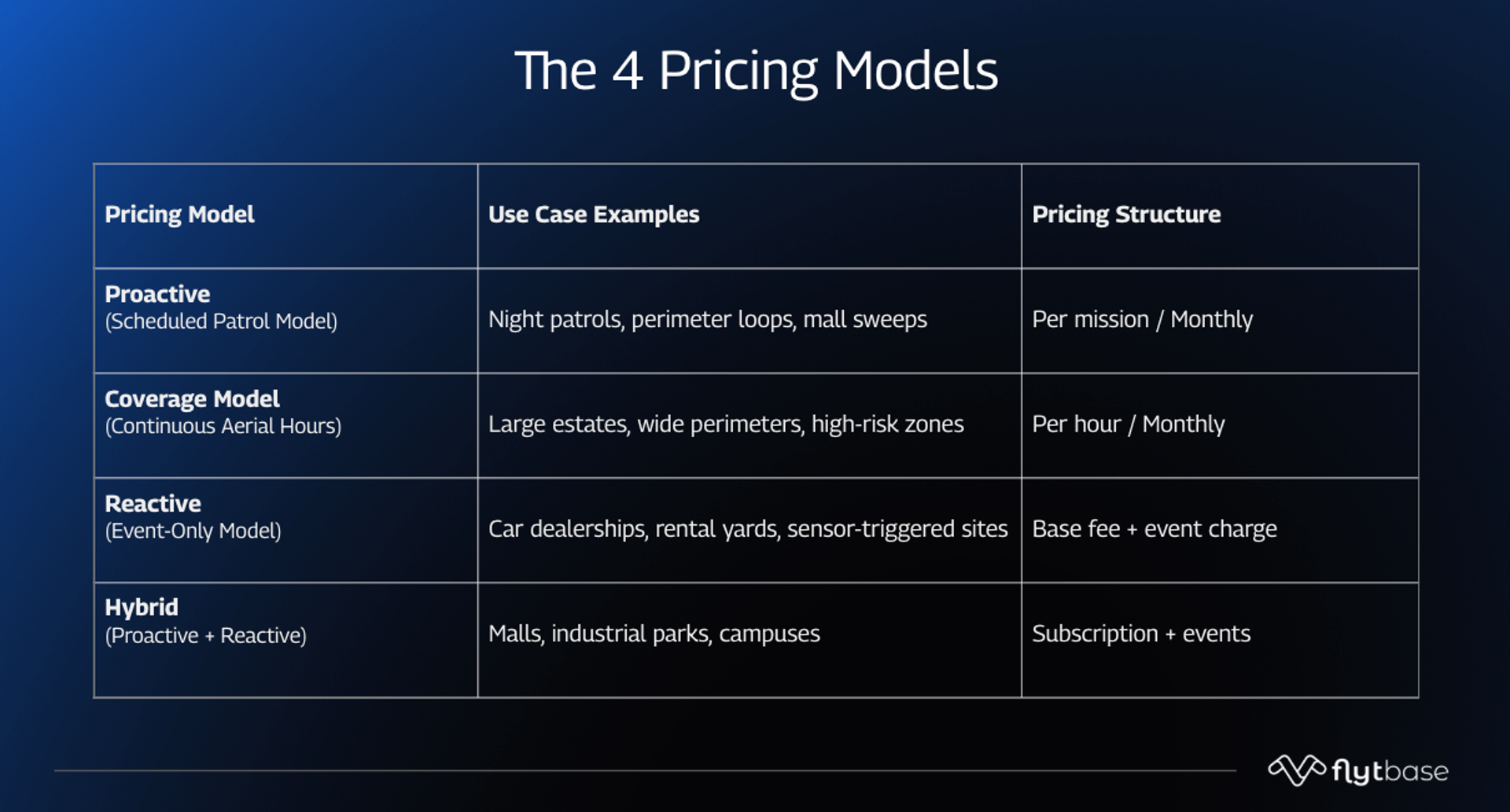
Four Pricing Models Customers Understand Immediately
Your pricing must mirror how customers already think about risk and coverage. The four models consistently work across regions. Customers adopt these models quickly because they match existing security contracts.
How Providers Engage Customers: Full-Stack vs ROC-as-a-Service
Your business model is just as important as your mission plan.
1. Full-Stack Security Service
You own hardware, software, insurance, reporting, and operations. Customers pay for outcomes while avoiding capital expenditure.
2. ROC-as-a-Service
Customers own hardware, while your ROC manages operations, reporting, and compliance.
Both models work. The choice depends on budgets, risk appetite, and the customer’s internal capabilities.
The Practical BVLOS Path Security Teams Follow
Many providers enter BVLOS discussions with the wrong expectations. The real path regulators expect to see follows three steps.
1. Start With Observer Operations: Pilot sits in the ROC, observer on the ground. Regulators watch how you operate, record missions, and manage safety.
2. Progress to Shielded BVLOS: Flights run within predefined corridors and altitude bands. Regulators approve this more easily for malls, estates, car lots, and industrial sites.
3. Advance to Full BVLOS: Once you show 30–45 days of clean logs, repeatable SOPs, and no incidents, you qualify for waivers that allow nationwide or region-wide operations.
This three-step model is how multiple FlytBase partners scaled from one site to many.
A Framework for Designing Missions That Actually Reduce Risk
The five-question framework is one of the most practical tools for mission planning.
Five Questions That Shape Every Mission
- What risk are we reducing?
- When does the risk peak?
- Where are the blind spots?
- How fast should the drone respond?
- How much area can one system cover?
These questions allow providers to map missions to outcomes instead of assumptions. A mall, for example, typically needs thermal sweeps, parking-lot coverage, loading-dock monitoring, and forest-edge scans based on incident patterns.
A Three-Phase Deployment Model That Works Across Regions
Deployments across industries follow the same structure.
Phase 1: Foundations
Dock setup, connectivity, weather sensors, observer missions, and mission logs.
This phase builds regulatory trust.
Phase 2: Integrations
VMS connection, sensor triggers, automation workflows, alert routing, and ROC visibility.
This is where ROI becomes clear.
Phase 3: Scale
Consistent missions, centralized operations, multi-site workflows, and BVLOS expansion.
This is when autonomous drones move from pilot projects to standard operations.
Three Must-Haves for Any Autonomous Security Program
1. Data Security Options for Enterprise Needs: Cloud, on-premise, in-country cloud, and air-gapped deployments ensure sensitive footage and telemetry stay compliant.
2. Hardware Agnosticity for Real-World Flexibility: Different sites need different airframes. A single platform must support quads, fixed-wing, and multiple dock models.
3. Integrations for Seamless Workflows: VMS, alarms, AI detections, UTM, and IoT sensors all need to work together.
This is where autonomous response shifts from a camera view to a complete security workflow.
Where Security Providers Go Next
Autonomous operations scale when missions, compliance, data, and workflows live in one coordinated system. Security providers across industries use FlytBase to run consistent, outcome-focused patrol programs that grow with each new site they add.
If you want help designing your next site or ROC workflow, our team is here to support your deployment and BVLOS roadmap. Contact us at flytbase.com/contact-us.