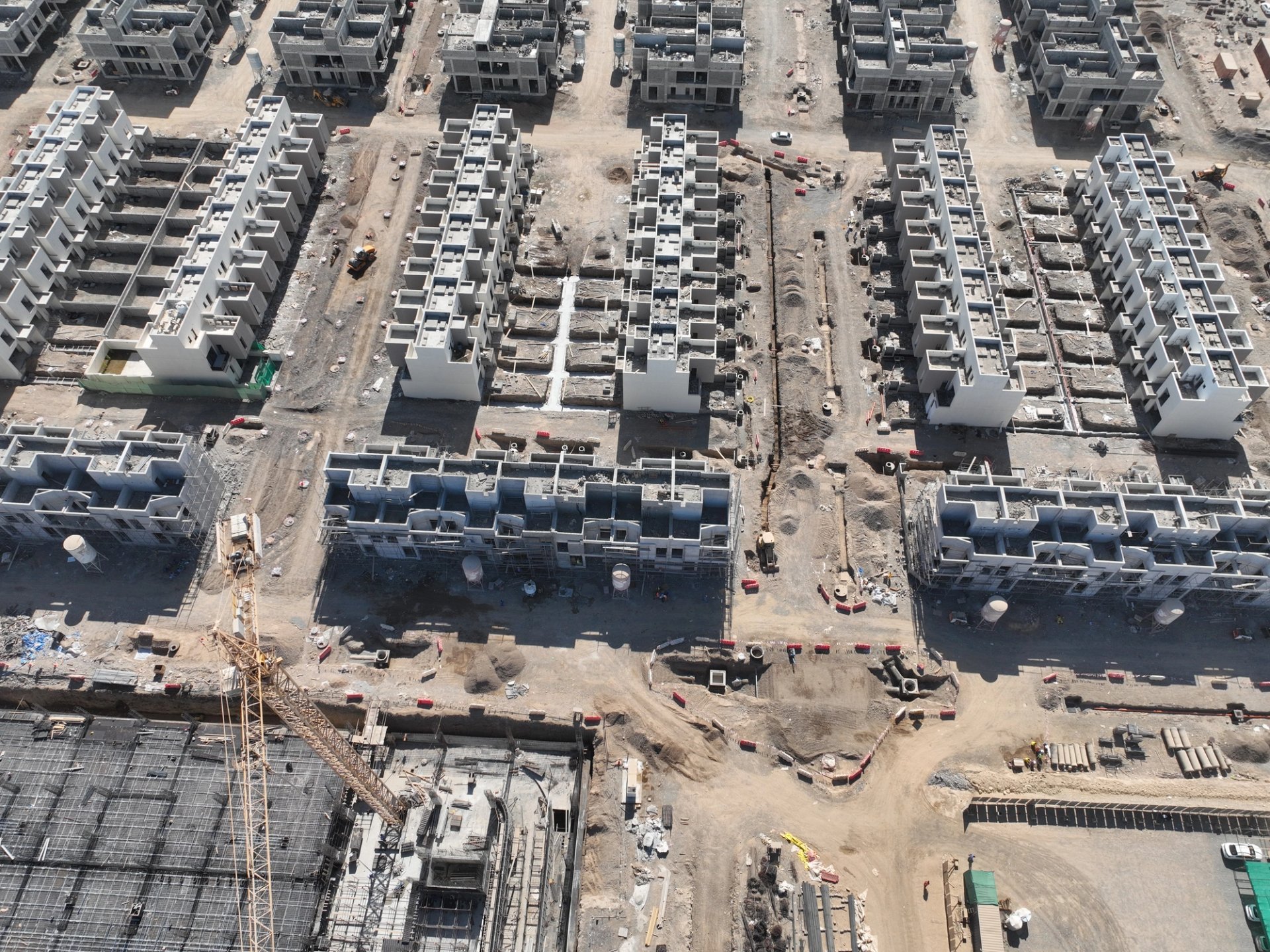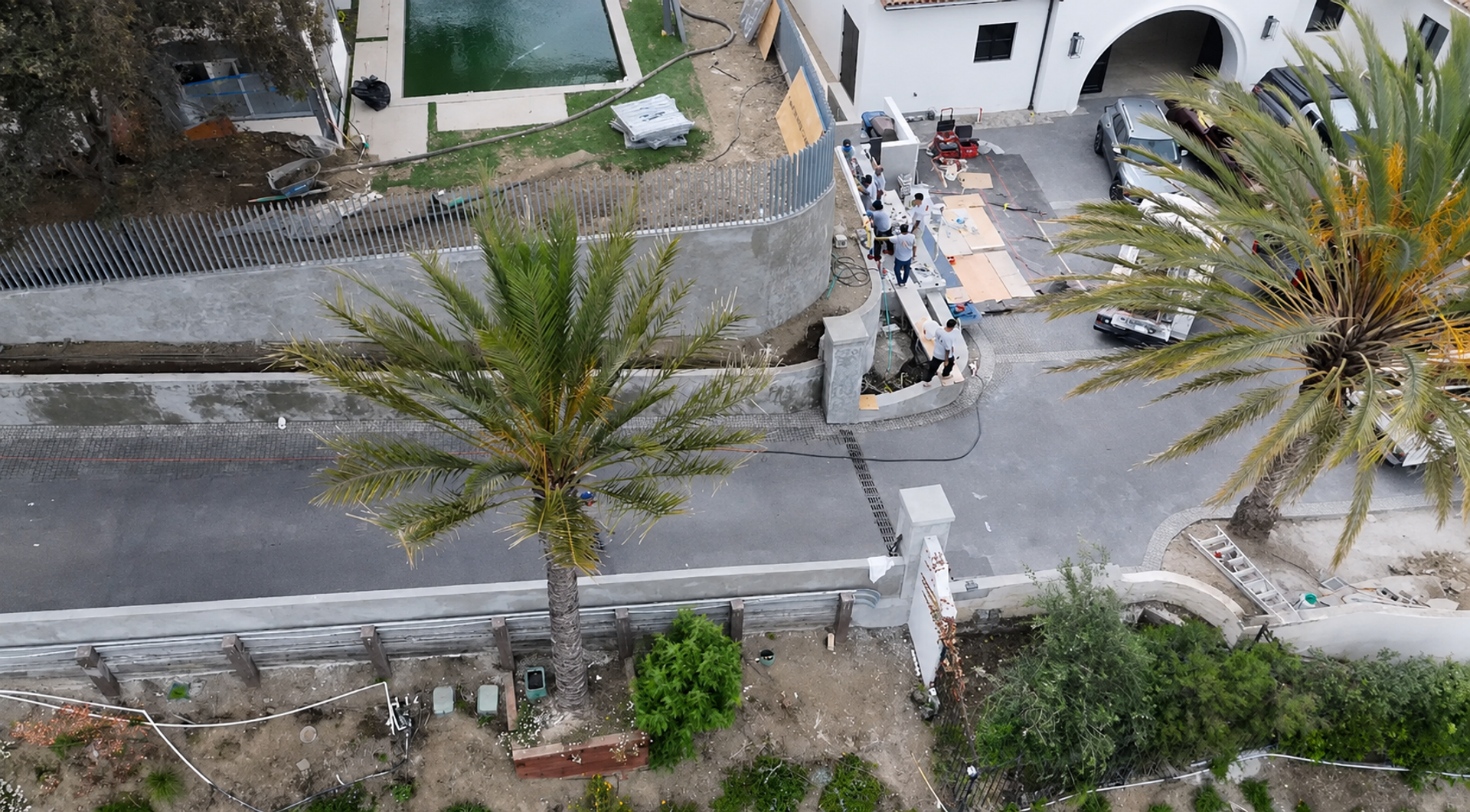
A private residential estate spans approximately two acres with a hillside perimeter, a front gate entry point, and multiple open access routes created during an active construction remodel. The renovation introduced rotating crews, daily deliveries, and shifting access points across the property over several months. Fixed cameras covered just 40% of the exterior, leaving the majority of the perimeter unmonitored at any time of day. Verifying that construction crews were on-site required a physical visit every other day. The property needed surveillance that could cover the full site continuously, not just the angles a static camera could see.
The challenge
Managing a major home remodel creates a security problem that fixed cameras are not designed to solve. Construction sites have rotating crews, constant deliveries, and multiple access points. The conditions change every day. A camera captures what happens in front of it. It does not follow the situation.
- The existing security infrastructure had no mobility. Daniel's fixed cameras covered defined points on the property. A two-acre site during active construction is not a defined point. Coverage gaps were a function of the technology, not the configuration.
- Contractor oversight had no independent verification. Confirming that crews were on-site and working as contracted required someone to be present. That was not always practical, and relying on contractors to self-report was not a workable alternative.
- An active construction period created new exposure. Open access points, unfamiliar personnel, and high-value equipment and materials on-site are conditions that opportunistic theft is specifically suited for. The vulnerability was structural, not incidental.
- The decision was proactive. No single incident triggered it. Daniel identified the gap, assessed the available technology, and deployed before anything went wrong.
The solution
Daniel deployed a DJI Dock 3 on the roof of his estate, paired with a DJI Matrice 4TD and integrated with the FlytBase platform. It operates over WiFi and requires no pilot at the property for any mission.
From the day it launched, the drone has followed the same cycle: lift off from the rooftop dock, fly the perimeter, return autonomously, recharge, and wait for the next scheduled flight. The interval between flights is one hour. The duration of each flight is just over four minutes. FlytBase manages automated mission scheduling, route execution, and remote pilot access.
AI-R object detection is already integrated into the system. Event-triggered dispatch is in the final configuration stage: when it goes live, the drone will also launch automatically in response to motion detected at the front gate or on the adjacent hillside during late-night hours, in addition to the scheduled hourly cycle.
The deployed technology stack:
- DJI Dock 3 autonomous drone-in-a-box, rooftop-mounted
- DJI Matrice 4TD
- FlytBase platform for mission scheduling, remote execution, and fleet management
- AI-R Object Detection for real-time detection
- WiFi connectivity
How it works
Every mission is initiated by FlytBase on a scheduled cycle. The dock opens, the drone launches, executes the perimeter patrol, and returns to recharge without any action required on-site.
- Perimeter patrols cover the full two-acre site on a consistent route. Each flight is approximately four minutes. The drone returns to the dock, recharges, and the next mission queues automatically. Over twelve months, that cycle has run more than 8,000 times.
- Construction oversight missions during the remodel period provided the operations log that became relevant when two delivered laptops went missing. The flight footage from the relevant window showed who had taken the packages and when. The footage was timestamped and provided evidence that no fixed camera at the property could have captured.
- Upcoming AI-triggered dispatch will add a second operational mode alongside the scheduled cycle. When motion is detected at the front gate or on the adjacent mountain slope during designated hours, the drone will launch without waiting for the next scheduled flight.
Implementation
The deployment required no regulatory approvals beyond standard airspace compliance for the location. The absence of a complex approval process reflects the residential context, and allowed the system to go from procurement decision to live operations without a long lead time.
Connectivity was straightforward. The property has WiFi infrastructure sufficient for the dock and FlytBase integration. There was no need to assess alternative connectivity options, which simplified the pre-deployment planning considerably compared to remote or industrial deployments.
The system launched in a single configuration. Unlike multi-site deployments where phased rollouts are used to validate performance before expanding, this deployment covered the full scope from day one. One dock, one drone, one site, continuous operation from launch.
The results
- Property coverage went from 40% to 100%. The fixed cameras left the majority of the exterior unmonitored. The drone covers the full two-acre perimeter on every hourly patrol. That 60% gap no longer exists.
- On-site construction oversight visits dropped by over 90%. Before the drone, verifying crew activity required visiting the property every other day, roughly fifteen minutes each time. Hourly aerial confirmation made those visits unnecessary.
- Package theft identified via flight-log footage. When delivered laptops disappeared during the remodel, existing security infrastructure provided no usable evidence. The drone flight log from the relevant time window showed who had taken the packages. This was not a designed use case — the footage existed because the drone had been flying on schedule, as it always does.
- 8,000+ missions completed at 99.9% uptime. The system has run every hour since June 2025 across twelve months of changing seasons and conditions, without meaningful interruption.
The way ahead
AI-triggered dispatch is in final configuration. When it activates, the system will respond to detected motion at the front gate and on the hillside perimeter during late-night hours, launching a mission outside the scheduled cycle. The hourly patrol establishes continuous baseline coverage. Event-triggered dispatch closes the gap between flights when it matters most.
The transition from scheduled-only to scheduled plus event-based represents a meaningful capability shift. The hourly cycle was selected because it provides consistent monitoring without relying on any trigger to function. Event-based response adds a reactive layer on top of a proactive foundation. The combination is more capable than either mode alone.
Conclusion
One private estate, monitored end to end, 24 times a day, with no one on-site to operate it. Twelve months, 8,000+ missions, 99.9% uptime, and a theft case closed from footage that no fixed camera could have produced.
The gap this deployment closed was not a technology problem. Forty percent of the property was simply outside camera coverage, and no ground-based system was going to change that. The drone changed it on day one. For property owners and investors who want continuous aerial awareness without staffed security, this is not a proof of concept. It is a year of production.
Frequently asked
1. How does autonomous drone monitoring compare to fixed cameras for property security?
Fixed cameras cover specific points. A drone covers the full perimeter on every flight, from an aerial perspective that no fixed mount can replicate. The more meaningful difference is in incident response. When a package went missing from Daniel's estate, the fixed cameras had no relevant footage. The drone did. It had been flying the relevant area on schedule. That footage existed because the system operates continuously, not because anything unusual had been flagged.
2. What infrastructure does a residential autonomous drone deployment require?
The Daniel Yomtobian deployment runs on standard WiFi. The dock is rooftop-mounted and connects to the property's existing network. No specialist connectivity infrastructure was required. The hardware requirement is a suitable mounting location for the dock and power access. For properties without WiFi coverage at the intended dock location, a network extension or LTE backup would need to be assessed during site planning.
3. What does FlytBase add to a DJI Dock 3 deployment beyond the DJI native software?
FlytBase provides the mission scheduling, remote fleet management, and operational oversight layer that turns a drone and a dock into an autonomous program. In this deployment, it manages the hourly flight schedule, handles mission execution, and provides the remote pilot interface. The upcoming AI-triggered dispatch functionality runs through FlytBase as well. The platform is what makes the operation sustainable without on-site staffing.
4. Is autonomous residential drone operation subject to FAA regulatory requirements?
Standard FAA Part 107 rules apply to drone operations in the United States, including residential deployments. Operations within controlled airspace require prior authorization. For locations outside controlled airspace with appropriate altitude compliance, the regulatory pathway is straightforward. This deployment did not require special waivers. Any operator considering a similar setup should confirm the airspace classification for their specific location before procuring hardware.