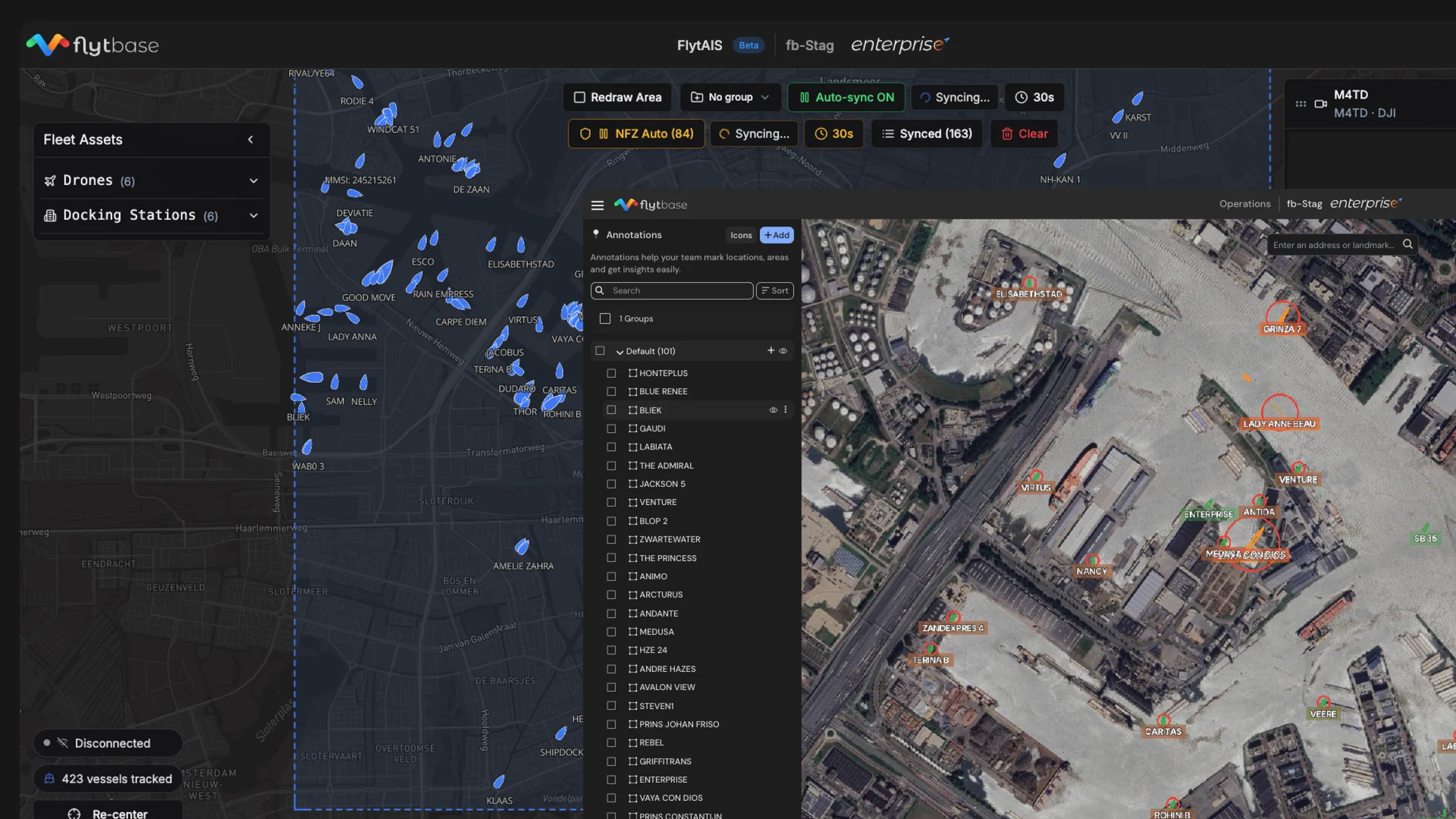
Maritime drone operations take place in environments where vessel traffic is constantly changing. Ships arrive, dock, reposition, and depart throughout the day, creating a highly dynamic operational environment for drone teams working in ports and maritime facilities. Yet drone operators currently plan and execute missions inside FlytBase without any native awareness of vessel movement.
As a workaround, operators keep separate AIS platforms such as VesselFinder or MarineTraffic open in parallel browser tabs. They manually monitor vessel positions, cross-reference coordinates with FlytBase maps, and adjust mission plans accordingly. This fragmented workflow forces constant context switching and significantly increases operational overhead during time-sensitive inspections.
AIS Flink eliminates this gap by bringing live vessel intelligence directly into the FlytBase operational map. Real-time AIS feeds stream vessel identity, position, speed, heading, and dimensions directly into the dashboard, allowing operators to visualize maritime traffic within the same interface where missions are planned and executed.
Instead of manually reconciling two systems, operators gain a unified situational awareness layer. Ships appear as live objects on the map, continuously updating as they move through the port environment. Drone operators can immediately understand how vessel traffic impacts flight planning and inspection opportunities. This visibility becomes critical in ports where flying over active vessels is prohibited or tightly regulated.
Without embedded vessel awareness, operators risk launching missions over newly docked ships or missing inspection windows when vessels arrive at berth. AIS Flink transforms vessel awareness into an operational intelligence layer. The system can dynamically incorporate vessel movement into operational planning and enable event-triggered workflows when ships dock or depart.
Instead of reacting manually to vessel movement, drone operations adapt automatically to the changing maritime environment. The result is a shift from reactive drone operations to context-aware autonomy. Operators gain a single operational interface that understands both airspace and maritime activity, reducing cognitive load while improving safety, compliance, and response speed.